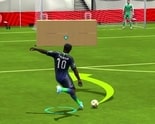
You kick off from the center circle, tap a quick pass out to the wing, and watch the defender read it half a step too early anyway. That small gap between what you meant to do and what actually happens on screen is the first thing FIFA Soccer teaches you, long before any match ends in a win or a loss.
| Genre |
Arcade soccer |
| Setting |
A standard soccer pitch, single matches against the computer |
| Core Task |
Pass, shoot, and defend across a full match |
| Win Condition |
Outscore the opposing side before full time |
| Best For |
Players who want short, casual matches with simple controls |
Matches and Match Structure in FIFA Soccer
Each match runs on a compressed clock, split into two halves with a short break between them, condensed into minutes instead of a full ninety. A referee still calls fouls and offside, and a tied score at full time pushes into a penalty shootout rather than ending flat.
New players tend to rush the opening minute, launching shots from well outside the box before building any real attack. The game rewards patience more than it looks like it should — working the ball through midfield beats sprinting straight at the goalkeeper.
Once the first half ends, the short break resets momentum, and matches that felt one-sided early can shift once the second half kicks off.
Controlling the Pitch in FIFA Soccer
Passing, shooting, and tackling run through a small set of controls that stay consistent from kickoff to full time, keeping the learning curve short. The goalkeeper reacts automatically on defense, but timing a shot to beat them still takes a few missed attempts.
Beginners commonly mistime tackles and give away fouls near their own box, turning into a dangerous direct set piece for the opposing side. Learning when to hold off on a tackle is one of the quieter skills the game expects.
Difficulty scales mainly through how quickly the defense closes down space, so an easier match can feel a full step faster once difficulty rises. Holding a clean sheet becomes the real challenge then, since one mistimed tackle is often all it takes to concede.
- Does FIFA Soccer include a penalty shootout? A match that ends level after full time moves into a penalty shootout rather than settling for a draw. It’s the only way a tied match gets resolved.
- Can you change the difficulty in FIFA Soccer? Difficulty settings adjust how aggressively the computer-controlled defense presses and closes down passing lanes. Higher settings leave far less time to set up a shot.
- What happens if you commit too many fouls in FIFA Soccer? Repeated fouls near your own box hand the opposing side dangerous set-piece chances close to goal. The referee tends to punish reckless tackles more harshly than clumsy ones.
FIFA Soccer keeps its appeal in that gap between a simple control scheme and a match that still demands real timing once the difficulty rises. Between the penalty shootout tension and the referee’s whistle cutting off a promising attack, a single match rarely plays out the same way twice.